What is happening to the Frogs in Central America?
Costa Rica & Panama’s Struggle to Save Endangered Frog Species
For several years now, scientists in Costa Rica and Panama have been tracking what has become a very worrying disease among frog populations across the globe. The Chytrid fungus has made it to the far reaches, and it seems no species of frog is immune to this awful disease which attacks the keratin in their skin.
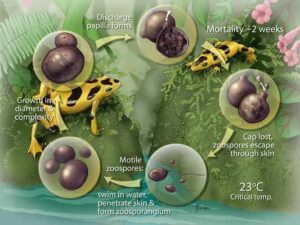 The infectious disease Chytridiomycosis is the cause of the Chytrid fungus, which attaches itself to any part of the frog’s skin which contains keratin… namely its pelvis, digits, and mouth, and continues to spread from there. Because a frog breathes through its skin, when it is covered in the fungus, it’s the equivalent of losing lung function or being asphyxiated… and ultimately the disease is fatal.
It is particularly disconcerting that frog populations the world over are experiencing a marked decline in numbers due to this disease, which is spreading quickly and constantly. There is no doubt that humans ability to travel great distances is wonderful, and that the ability to trade goods on a worldwide scale is a boon for most anyone. But one downside to this world becoming more and more accessible is just that: it’s more accessible to more and more people, making diseases and the like much more mobile in the process. We travel more and we trade more. Specific to this situation: millions of amphibians are shipped all over the world annually, and many seem outwardly healthy until it is too late.
The Chytridiomycosis disease can be spread through frog to frog contact, and also through the water in its infected tank. So it is easy to see how unknowingly receiving delivery of an infected frog, and dumping its old tank water outside your house in favor of cleaning the tank and filling it with new water, can introduce the disease to your neighborhood very fast and it can go undetected until its way too late. This is believed to be happening in neighborhoods the world over, and is of course hastening the spread of the disease.
But it is also heartening to see neighborhoods helping where they can, and this does happen often. Once a while back, a team of Smithsonian scientists were rescuing frogs in Panama from colonies that were infected with Chytrid and moving them to a safe house… but they didn’t yet have a safe house. So the closest hotel actually donated a few of their guest rooms and even a holding facility so the frogs would have a safe place to go! How awesome is that?
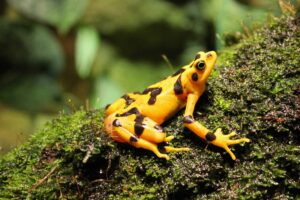 As we know, Costa Rica has long been on the forefront of animal preservation and disease research. Frogs in Costa Rica are particularly of utmost importance as the world’s most diverse frog population is found near here. In addition, Costa Rica is one of the only places some species of frogs are found at all. Recently in Guanacaste a behavioral study was begun to determine why some species of frogs appear resistant to the fungus. It is hoped that the exact way in which they are resistant can be isolated, and possibly a vaccine created for the less-resistant frogs. You can even visit Panama’s El Nispero zoo in El Valle de Anton which has two of the very rare Golden Frog in a safe place after a chytrid scare raised concerns that we might lose this species forever. Saving our world’s frog population is a battle on both the research side and the conservation side.
Unfortunately there are many factors contributing to the worldwide decline in numbers of all sorts of animals, not just frogs. It is of course inevitable that life naturally ebbs and flows, but environmental factors do play a part in this just as human activity does. But you can do your part to stop the spread of the Chytridiomycosis disease in frogs. If you are in the market for a frog and considering purchasing one from a pet store, please do your research to learn the source of the frog. Only follow through on purchases where you can be sure of the frog’s origin. If you are not sure of where it came from and that it is disease free, it would be a wise choice not to purchase that frog and to instead seek one out from a reputable dealer.
It’s clear to see that researchers from Costa Rica, Panama, and indeed the world over are doing what they can to deepen their understanding of the Chytrid disease and take the necessary steps to stop its spread. Recently there has been a bit of success with probiotics, and certain captive breeding programs set up to ensure there is no introduction of the Chytrid disease going forward. Still other scientists are working to understand exactly how the Chytrid fungus interacts with the colonies sharing its water. It is thought that tackling the issue from many different angles will bring about a positive resolution much sooner. This is where the multitude of ranariums in Costa Rica, the scientific collaborations in Panama, and the good-hearted efforts of locals pitching in where they can, will make a huge difference in our education on the subject and the swiftness with which a cure is found. We’ve got our fingers crossed tight that someone is able to determine a fix for the spread of Chytridiomycosis in frogs, before it’s too late!