


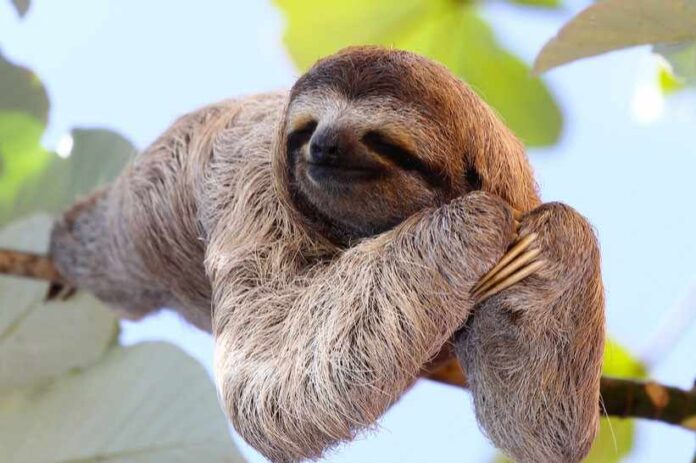
FAQs & Fun Facts About Sloths In Central America
The elusive sloth, aside from its perpetual smile and deliciously lazy life, often makes the list of the world’s favorite animals. Yes, they’re undoubtedly very cute. However, little do people know, these endangered beings are also nothing short of fascinating.
Luckily, there are an abundance of sloths in Central America, particularly in Costa Rica. Your chances of seeing sloths on your trip to Central America very high if you know where to look. However, Pygmy sloths in Panama are on the global endangered animal list, making it extremely important to do everything we can to protect their natural habitats.
Without further ado, let’s dive deeper into what makes these creatures so fascinating with some FAQs about sloths:
- What kind of sloths are found in Central America?

The species of sloth that can be found in Costa Rica are the Hoffman’s two-toed sloth, an elusive nocturnal species that naps throughout most of the day, and the Brown-throated sloth. The latter has three front toes rather than two. Brown-throated sloths are slightly smaller than their two-toed relatives because they are a little more active. There is also a species of Pygmy sloth that live solely in Bocas Del Toro in Panama. When it comes to being able to see sloths in Panama, this is extra special because there are less than 100 of these Pygmy sloths left in the world!
- Why are sloths soooo sloooow?
As nice as it would be to leave it at the fact that they are simply lazy and can’t be bothered to move faster, that’s not exactly true. A sloth’s slowness is actually a survival skill. They have extremely slow metabolisms and digestive systems. So slow in fact, sloths can actually take over two weeks to digest a single meal! The sloths signature slowness conserves energy and allows them to survive on a simple herbivore diet of plants, leaves and the occasional insect.
- Why is their fur so weird?

Sloths have a lot more going on than what meets the eye. They have a symbiotic relationship with algae, fungi and insects like moths that give them a greenish hue. This not only helps them camouflage into their surroundings a little better, but also ends up making them very unappetizing to most predators.
- Where can I go to see sloths in Costa Rica or Panama?

When it comes to the best place to see sloths in Panama or Costa Rica, Bocas del Toro, Panama and Puerto Viejo, Costa Rica are among the best. In either destination, it is best to go with a guide who has a keen sloth-spotting eye. These animals are the masters of disguise, and their slow movements make them very hard to spot high up in tree canopies. An excursion to a sloth sanctuary or on a guided hike are some of the best ways to see sloths. Again, going with someone who knows what to look for is always a great way to increase your chances of spotting sloths.
10 Additional Fun Facts About Sloths in Central America:
- Pooping is the most dangerous thing sloths can do. No, really though. They have to climb down from the safety of their home up in the trees around once a week to “relieve themselves” and this counts for a large percentage of sloth mortality.
- Their long claws, sometimes extending over 4 inches long, make it tough for them to move on land. However, they are extremely strong swimmers with a breaststroke that is equal to that of a strong human swimmer.
- Sloths are not necessarily dangerous to humans unless they are made to feel at risk. However, it is never a good idea to try to handle a wild sloth.
- Around 10,000 years ago, a “megasloth” used to roam around in Central America. There is evidence to suggest that they grew up to the size of a modern day rhinoceros!
- Three-toed sloths can turn their head 270 degrees.
- Sloths are distant relatives of anteaters and armadillos, all thought to have first evolved around 60 million years ago.
- Sloths can slow their heartrate to one-third of its normal pace, meaning they can hold their breath underwater for up to 40 minutes!
- Due to the entire world of microbes like algae, fungi and bugs in their fur, sloths are known as some of the worst-smelling creatures on the planet.
- Sloths generally live in the same tree for years, or even for their entire lives.
- Sloths can live up to 30 years old.

See….sloths are pretty darn fascinating creatures. We hope you have the chance to get to see them in the wild during your Costa Rica or Panama vacation.
Happy Travels!