


Costa Rica’s Mangrove Forests
Why Mangrove Forests Are So Unique & Where You Can Find Mangroves in Costa Rica
If you are planning a trip to Costa Rica, one of the must-see things to do on your bucket list should be explore the incredible mangrove eco-system that thrives here.
What Are Mangroves?
Plainly explained, mangroves are a variety of shrub and tree species that live along sea shores, rivers, and estuaries. This means a mixture of both salt and freshwater and muddy shores. Mangroves live in the tropics and subtropics. This means hot & humid conditions. Needless to say, not the most ideal conditions for any living thing (especially not me!). However, mangroves are remarkably resilient and adaptive and have evolved to be some of the toughest forests in the world. Basically, mangroves are the ultimate survivors…so far.
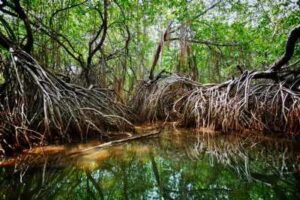
What Kind of Environment Do Mangrove Forests Thrive In?
Mangroves can only survive in tropic and subtropic climates, meaning they typically thrive between 25°N and 25°S of the equator. They cannot survive freezing temperatures, so this is the only environment they can thrive in. They are already fighting the forces of separating saltwater from freshwater, let’s not throw in battling freezing temperatures too.
This map shows you where the densest and most biodiverse mangrove forests are found in the world.
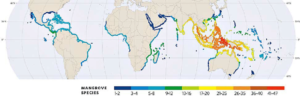
There are 80 different species of mangroves in the world, but only 15% of the world’s population of mangrove forests can be found between North and Central America. In fact, out of 80 species, there are only 7 species of mangroves found in Costa Rica. The largest mangrove forest in the world can be found in Sundarbans, Bangladesh. Spanning over 140,000 hectares, Sundarbans mangrove forest is actually a UNESCO World Heritage Site.
Where Can You Find Mangroves in Costa Rica?
You can find mangrove forests scattered up and down both the Pacific and Caribbean coasts of Costa Rica. There is a bit of conflicting information out there as to exactly how much area they cover, but it is guesstimated that there are about 35,0000 hectares (86,000 acres) of mangrove forest in Costa Rica.
Certainly, the densest population of Mangrove forests can be found in the Térraba-Sierpe National Wetlands in the Osa Peninsula. As one of the least populated and one of the most biologically diverse regions of Costa Rica, the mangroves and wetlands stretch from the Panama border all the way up to Uvita and Dominical. Golfo Dulce is one of the most spectacular, but narrow trails make it only accessible by kayak or canoe. Sierpe Terraba can be accessed by larger boats.
Further north in Manuel Antonio, there is an important mangrove forest at Damas Islands Estuary. This is actually one of the most visited wetlands on the southern Pacific due to its proximity to the popular destination. Ecotourism from Manuel Antonio is well-developed and operate using sustainable practices. There are both narrow and wide channels making the Damas Islands mangrove forest accessible by kayak or larger boat.
In northern Guanacaste, there are over 39 different sets of mangroves stretching the northern shores and waterways. One of the most accessible is the estuary that flows between Playa Grande & Tamarindo. The mangrove estuary runs through Las Baulas National Park and ends at the mouth of the Tamarindo River. This estuary is wider and is accessible by both boat or kayak.
What Kind of Living Things Will I Find in Costa Rica’s Mangrove Forests?
 Birds, birds and more birds! In fact, over 850 species of birds have been found here, and mangroves are some of the best spots for bird watching in Costa Rica! Due to the dense protective nature of the mangrove forests as well as the nutrients it harvests, birds from all over the continent spend time here. You might say the mangrove canopy is like Club Med for birds. You know, great climate, comfortable and safe accommodations, and an all you can eat buffet of mollusks, worms, small fish, crabs, frogs, and even mice.
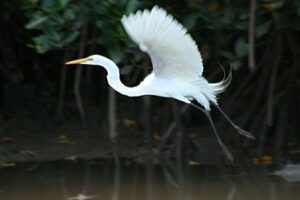 At water level, you can find a wide variety of waterfowl in Costa Rica such as kingfishers, egrets, white and pink ibis, green heron, tiger heron, a variety of ducks and many more. Overhead, you can spot scarlet macaws, parrots and parakeets, and skimming the water you will find flycatchers and trogons. Each mangrove has its own migration of bird species, so each mangrove has its own unique set of birds to seek out.
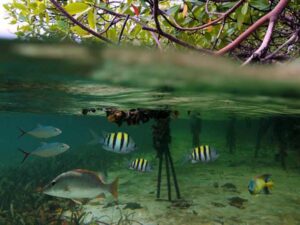
Aside from birds, there are all sorts of other creatures that thrive here. Crabs play an important part in the mangrove ecosystem. These scavengers eat the decaying and fallen mangrove litter and help recycle nitrogen which is super important for the survival of the ecosystem. Mollusks of all sorts thrive in the protection of the mangroves as well as several species of small fish…again, are you getting the whole eco-system thing? Every part of the mangroves depends on each other.
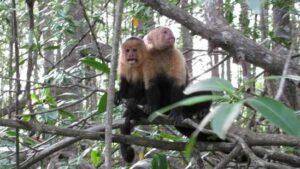
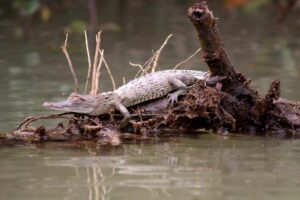
However, if you prefer great photo ops with wildlife, Costa Rica’s mangroves are THE place to be. Caimans and crocodiles can be found swimming alongside your kayak. White-faced capuchin monkeys, squirrel monkeys, and howler monkeys all take refuge in the safety of the mangrove forests. Iguanas can be found sunning in the branches and the occasional boa can be found curled up there as well.
What Is the Importance of Mangroves in Costa Rica and in the World?
Did you know mangrove forests are shown to absorb 4-5 times as much carbon as regular forests! Incredible, right! But that is just one amazing fact. In reality, there are several reasons that Costa Rica values its mangrove forests. There are a million and one reasons the world needs to value the mangrove forests. The answer is a bit more complex, but this quick video from the Mangrove Action Project breaks it down in simple terms.
[embedyt] https://www.youtube.com/watch?v=KhLlqdPB_Rs[/embedyt]
Here are a few more fun facts about how amazing the mangroves are.
- Mangroves make up only 1% of our planet’s overall surface, yet they are nearly 5 times more powerful at combating climate change than tropical upland forests.
- Fish and shrimp use the mangroves as a nursery until they are mature and strong enough to venture back into the sea or processed by fishermen or fisheries. This is a huge economic boost for locals.
- Over 100 million people in the world live near mangroves. These mangroves generate approximately $33-$57,000 per hectare annually in coastal preservation, timber, fishing, food, and medicine. Not so shabby for a climate change fighter.
- Mangroves can adapt like aliens! They can morph to balance both saltwater and freshwater environments. They grow extensive roots keeping their trunks above the water line so that they can breathe. And their seeds can change density to either root vertically or float horizontally in order to keep breathing air up to 300 days in order to survive.
- They protect us from hurricanes, tsunamis, and tidal surges! A coastal border of mangroves 100 meters thick can reduce wave height by two thirds! Not to mention, if you tried to build a sea wall with the same protection, it would be MUCH more costly. And a sea wall does not provide fishing or other benefits that generate money rather than maintenance costs. Hmmmm, hey USA, maybe you can build your border wall across the Rio Grande by planting mangroves instead of a concrete wall.
What Is Costa Rica Doing to Protect Mangroves?
Mangrove populations have declined by 35% in the past 40 years. Mangrove populations continue to be destroyed at a rate of 1% per year to this day. (Um…what is wrong with us? Why are we letting this happen?) All mangroves in Costa Rica are protected by law, but there is not always someone around to enforce that law. So, the best we can do is educate the communities on their importance so they have a sense of pride in protecting them. One of the best ways to educate people is ecotourism. And Costa Rica is one of the world leaders in ecotourism, so I think we are on the right track.
With climate change rapidly changing the world we live in, the protection of wetlands and mangroves is now a top priority for Costa Rica’s current president, Luis Guillermo Solis too. In 2017, his administration developed Costa Rica’s first National Wetlands Plan. This is a comprehensive action plan through including conservation management through 2030. They want to encourage the participation of the local communities with education and incentives and address how we need to adapt for the changing climate. They are also working on strengthening institutions to protect wetlands and mangroves in Costa Rica.
Compared to most countries, Costa Rica devotes a very large part of their taxes to environmental protection and restoration. Sustainable tourism has always been important to Costa Ricans. Their Certificate for Sustainable Tourism program is a model for the world to follow. Let’s not forget that Costa Rica was also a pioneer in the race to become Carbon Neutral.
So yeah, I would say Costa Rica values the protection of their mangrove forests. And you can consider Costa Rica to be an ethical travel destination this year.
For more reasons why it is important to protect and care for our mangroves, check out the World Economic Forums list of 5 Reasons to Protect Mangrove Forests For The Future.
Where Can I Get a Guided Eco Tour of The Mangroves in Costa Rica?
Mangroves are accessible from many popular destinations on the Pacific coast. You could probably rent a kayak and go it on your own, but a guided tour of Costa Rica’s mangroves is a thousand times better. If you really want to see all the animals up close, only the local guides know all their hiding spots. The guides also take pride in their country, are extremely knowledgeable, and love to share their knowledge with you. There is also the little detail about crocodiles swimming alongside your boat…
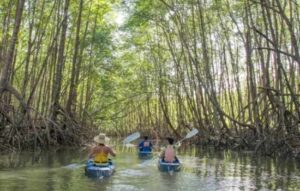
Now, as mentioned, a majority of Costa Rica’s mangroves can be found in the Osa Peninsula. As most of the trips there require overnight stay, we do not have any one-day tours to explore the mangroves there. However, if you are staying in Uvita or Domincal, you can Kayak the Guapil Mangroves which are just to the north.
In Quepos, just north of Manuel Antonio, you will find the incredible Damas Islands Mangroves. There are several ways to explore the mangroves depending your travel style. If you prefer to sit back and let the guides do all the work, then the mangrove boat tour is for you. If you are a bit more adventurous, then the Damas Island Mangroves Kayak tour is your best bet. On kayaks or SUP boards, you can navigate smaller canals that cannot be accessed by the larger boats. You can also explore the mangroves at night on either boat or kayak for a truly unique experience. And for those sport fishermen out there, you can join one of the mangrove fishing trips in the Damas Islands! Bonus, this provider offers transportation from as far south as Uvita, and as far north as Jaco and Herradura.
Speaking of Jaco, the Tarcoles River is most famous for the giant population of enormous crocodiles. However, the Carara National Park is borders the northern tip of the river, and you can find 4 different species of Mangroves here. The Tarcoles River Crocodile Safari takes you to explore the mangroves as well as close up encounters with some of the largest crocodiles in the Americas. And if you are coming to Costa Rica on a cruise ship, nearly all of our shore excursions from Puntarenas and Caldera Cruise ports include a Tarcoles River Safari. By the way, once you see the size of the crocodiles, you will understand why nobody offers kayak or SUP tours on the Tarcoles River.
Now, if you are staying in the resorts over in Guanacaste, the most accessible mangrove forest is located in Tamarindo. Under the protection of the Las Baulas National Park, the Tamarindo Wildlife Refuge and Tamarindo Estuary are a bird lovers dream. Just like Damas Islands, you can explore the Tamarindo mangroves in a boat, or choose a more adventures kayak tour of the Tamarindo estuary and navigate the narrower canals.

Finally, for the granddaddy of all Costa Rica mangrove tours, the Tortuguero Canals in the Tortuguero National Park are for those who REALLY want to immerse themselves in nature. For those arriving on a cruise ship, many of the Puerto Limon shore excursions include a visit to the Tortuguero Canals. However, if you really want to get the best experience, we highly recommend an overnight trip to Tortuguero. And the best part, transportation is included from San Jose, Arenal and Puerto Viejo. So even if you are inland and nowhere near the coast, you can still squeeze in a visit to the mangroves on your Costa Rica vacation.
Well, we hope you learned a bit more about the importance of the Mangroves here in Costa Rica. Hopefully you have the opportunity to experience them for yourself on your next vacation. If you need help planning, our activities specialists are always happy to help. Just zip us an email, we are just a click away!