


Panama Canal Draft Restrictions
Low Water Levels on Lake Gatun – A Grocery Bill Nightmare!
Did you know that the Panama Canal is one of the 7 Wonders of the World? It’s special, no doubt about it, and while the reasons for this designation are many, two really stand out: it’s an unrivaled engineering marvel, and it serves to connect the two halves of our world. Suddenly, with the Panama canal, importing items to the US from Europe was a logistical possibility! Divided no more, the entire world became a marketplace. What a wonder indeed.
In a previous Panama Canal Conservation blog we talked about the connectedness of every living being on this earth, and how conservation matters, specifically where this Wonder of the World is concerned.
What you do… what we all do… it matters. So we’re here to bring it home again for you.
The general consensus among experts is that we need to focus on (and prepare for) the fact that we will continue to see bigger extremes in weather. In other words, climate change is happening and we need to make a plan.
In Panama there was severe flooding in 2010, and for the last 5 years now we’ve seen drought conditions. That’s just the last few years, and that’s just in Panama; the severity of the weather on our planet overall has been ratcheting up for the last 20+ years. It’s really hard to deny anymore that something’s afoot.
The idea behind a watershed is that there is a reserve for when times are tight. Having a watershed is like saving for a rainy day, but in reverse: a watershed is saving for a very long, very dry day! A watershed is like a bank, and where the Panama Canal Watershed is concerned, the bank balance has taken a pounding the last few years. To say the least.
So, the situation we’ve got is two-fold: we need to treat a problem (low water levels) and prevent one too (climate change). We really need to get it together and come up with a plan, collectively, for the good of us all! We need each other, now more than ever. The extremely low water level of Lake Gatun, all way down in the Panama Canal, is really bad news for you.
Jorge Aleman_STRI
Yes… you personally.
“Why… me?”
Well, imagine this: you’re in the grocery store for your weekly shop. You’ve got $100 to spend, and you’ve gotten good at this budgeting thing! Sure, you pretty much eat the same things all the time, but you read recently that the average person only cooks the same 6-9 things regularly anyway.
You have a different meal for every day of the week, plus a couple of variations on lunches, so you’re feeling pretty good as you roll through the usual isles grabbing the same salad dressing, bread, Oreos, and breakfast bars that you get every week.
At the register, your groceries are bagged up and you’re looking forward to a total of about $90, because it’s Sunday and that means it’s Ice Cream Treat Day, when the cashier chirps “OK, that’ll be $125.73 please!”
“What?”
Yup. The draught in Panama just hosed your grocery budget my friend.
“… How? Did that happen?”
Well, in short: the boat that your soybeans came from Brazil on, couldn’t get through the Panama Canal, thanks to new “draft restrictions”. The Panama Canal was too shallow.
This created a higher demand for the few soybeans that did make it through. So your Oreos just went from $4.50 per package, to over $7.00. And the cost of your salad dressing more than doubled. You look for bread that doesn’t have any soy products at all, but you can’t find any.
Everything costs more, and everything seems to contain a soy product.
You’re standing in the middle of a grocery store when it really hits you: We’re all connected. We need to do something!
“Wait, back up… what’s a ‘draft restriction’?”
Every seagoing vessel has a big, heavy weight, called a “keel”, hanging below it. The keel is meant to keep the vessel upright; it is extremely heavy and can hang quite low… and the more load that’s on the boat, the lower it sits in the water. The keel offers stability in rough seas, so you don’t “keel over”.
The measurement of how much your keel hangs down, is what’s called your vessel’s “draft”. As in: “this freighter ‘drafts’ 25 feet at full capacity.” You could also say “the vessel ‘draws’ 25 feet” and it would mean the same thing in boat speak.
Draft restrictions basically mean that certain boats can’t pass through the canal because they draw too much when filled to capacity. The water levels are too low, they will run aground, and the watershed doesn’t have enough in reserve to keep the water levels any higher.
So, decisions have to be made:
- Send through smaller loads. The freighter draws 25 feet at full capacity, but only 15 at half. It can pass at half capacity. But that makes everything less efficient. It costs more.
- Reserve product until such a time as conditions improve. But that creates scarcity and jacks up demand. It makes everything cost more.
- Send product to other destinations by other means. This is not the way to keep the price point the same for the product. Diverting your shipment to other destinations is not an option in most cases. It will blow the retail cost sky high and no one will buy it.
In order for life to move on, one of these three options is going to have to get the “yes” vote. And, bottom line for you: your grocery budget (among other things) gets a gut punch. For many an Average Joe, it becomes a question of whether you’ll be able to afford gas this week, no matter which option is selected.
All because it didn’t rain enough and freighters are heavy.
How can you bring any change at all here?
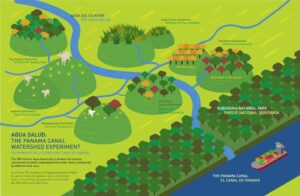
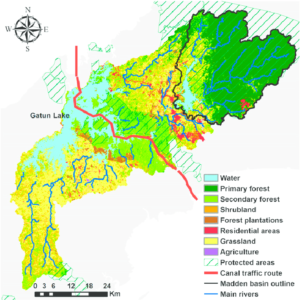
Conservation is so important. The watershed supplies nearly half of the water needed for the canal to function. Half! It is, so literally, our lifeline. One very key thread by which we are all connected.
Conservation. Prevention. Rinse, and repeat.
The facts are that the top five countries producing nearly 90% of the world’s soybeans are the U.S., Argentina, Brazil, China, and India. In 2014 Brazil exported almost 87 million metric tons of soybeans, bound for Asia, to be processed into everything from Oreos to Astroturf.
These are the soybeans that have to make it through the canal, and this… right here my friend… is why you can’t have Ranch on your fries in your jammies with Netflix anymore.
(We’re sure this goes without saying, but just in case: this is just one crop we’re talking about. Every single commodity that runs through the canal is affected to some degree.)
In the past couple of years there have been ideas to divert rivers and streams into the watershed, in order to ensure the levels in the canal stay high. But that isn’t widely viewed to be much of a sustainable solution. In fact, the Chagres River was dammed in order to create Gatun Lake in the first place. Like the saying goes: robbing Peter to pay Paul. Unfortunately we can’t keep doing that. It doesn’t work like that.
The only real answer we can see is the most difficult one, because it requires us all to dig deep and self-reflect: We need to take a look at our impact on the planet, on a personal level and of course, definitely, a corporate level.
We need to start seeing how the straw we throw away affects the health of our oceans, which affects the quality of our atmosphere, which affects climate change, which affects the cost of soybeans, which is why there’s no Ranch in your fridge, and you can’t pay for gas anymore.
Conservation: We can fill a dish tub and wash our plates in that, instead of letting water run down the drain while we scrub. Perhaps take a shower just every other day. Turn off the water while brushing.
Prevention: Quit single-use plastic. Ride your bike to work one day a week. Grow some veggies on your windowsill. Make your own bread… it actually doesn’t require any soy products… fancy that!
Yes, the future might seem bleak. But the power to change it lies in the hands of every one of us, and that’s pretty great right? Individuals and major corporations, we all have an impact. The evidence of that impact is found everywhere… oceans of plastic… extreme weather… smog…
But now that we can see the impact we’ve all had, the negative impact, we can reverse it. We can, we will, have a positive impact!
We can choose not to take the straw when it’s offered, we can turn off the water while we brush. We can take an empty container with us when we go out, so we can bring leftovers home, without Styrofoam. We can repair or re-use; we don’t have to buy new all the time.
We got ourselves into this, and we can get ourselves out, one decision at a time. That’s really exciting in a way, isn’t it? The power is within each of us, every day, all the time.
It’s time to make some new rules for ourselves. You in?
PS. Check out the Panama Canal’s Green Route action plan for future conservation. https://www.pancanal.com/eng/cuenca/LaRutaVerde-English.pdf